
OpenEvidence
OpenEvidenceMedical
4.9146.00 Reviews
- Version
- 2.9.25
- Installs
- 500.00K
- Age Rating
- Everyone
Screenshots

Our Review of OpenEvidence
 Analysis by Appyee
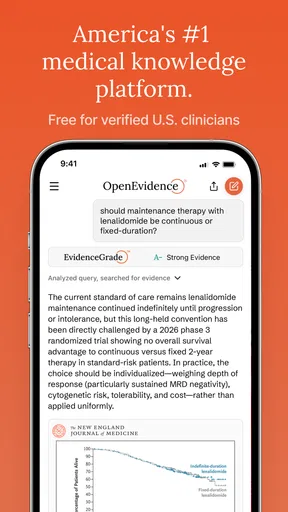
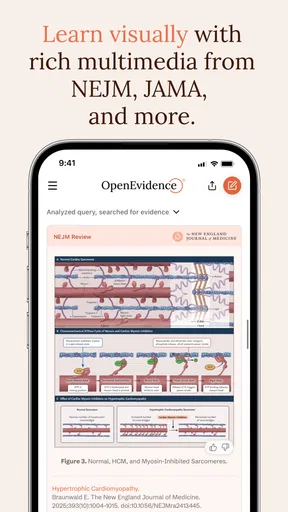
When I need a quick clinical reference, I usually want something more focused than a general web search and less cumbersome than opening a large medical database. OpenEvidence is built for that specific moment: it provides answers at the point of care and requires an NPI. I see it as a professional medical app rather than a general health tool for patients, and that distinction matters from the first screen.
Developed by OpenEvidence, the app sits in the medical category and is available free of charge. It has reached over 500 thousand installs and holds a 4.9 average from around 4.5 thousand ratings, which suggests that its intended audience is finding real value in the workflow. Still, those figures do not make it automatically suitable for everyone. The NPI requirement is a meaningful access condition, and the app’s usefulness depends heavily on whether you need clinician-oriented answers rather than everyday health education.
How OpenEvidence fits into clinical work
My first impression is that OpenEvidence is designed around questions that arise while making a decision, not around leisurely reading. A clinician may want to clarify a treatment consideration, review a clinical topic, or orient themselves before discussing options with a patient. That point-of-care focus gives the app a narrower identity than a typical symptom checker or wellness application.
The difference is important. A consumer health app often tries to translate symptoms into possible explanations, track habits, or provide broad educational material. OpenEvidence is aimed at accurate answers for professional use. I would not install it expecting a diagnosis for myself, a medication reminder, or a substitute for an appointment. Its role is closer to an accessible clinical information layer that can support a professional’s own judgment.
The requirement for an NPI also answers one practical question before installation: this is not an open medical encyclopedia for every visitor. If you are a patient researching a condition, you may find the access barrier inconvenient or unsuitable. If you are a qualified healthcare professional with the required identifier, the same requirement makes the app’s intended audience much clearer.
What the free price really means
OpenEvidence is free, so there is no purchase decision to make before trying it. That is a genuine advantage for eligible users who want to evaluate it alongside their existing references without committing money. I can test whether its answers fit my working style, whether the search experience feels natural, and whether it saves time in real clinical situations without first weighing a subscription.
At the same time, free access should not be confused with universal access or with a guarantee that it replaces every other resource. The NPI requirement remains part of the experience, and the app should be treated as an additional clinical aid rather than the sole basis for a high-stakes decision. Its price removes a financial hurdle, but it does not remove the need for professional interpretation.
I also appreciate that the free model makes the value question relatively straightforward. You are not deciding whether a paid plan is worth its recurring cost; you are deciding whether the app earns a place in your clinical workflow. For an eligible user, the sensible test is practical: does it help you reach a useful answer faster or with less friction than the references you already use?
Where the app can save time
The strongest value comes from reducing the distance between a question and a usable starting point. In a busy setting, I may not need a long textbook chapter. I may need a concise orientation before I review the patient’s history, compare options, or explain why a particular line of inquiry matters. An app centered on point-of-care answers is well matched to that need.
A realistic example would be a clinician preparing for a consultation while moving between appointments. Instead of opening several browser tabs, sorting through general search results, and trying to judge which page is relevant, the clinician can use OpenEvidence as an initial research step. The benefit is not that the app makes the decision on their behalf. The benefit is that it can help frame the question and direct attention toward the information that needs closer review.
That workflow suggests a useful habit: use the app before the decision, not after the decision as a way to justify it. If I search with a specific clinical question, I am more likely to notice what I still need to verify. If I search only after choosing a course of action, I risk treating a convenient answer as confirmation. The app is more valuable when it supports deliberate thinking rather than replacing it.
Another practical use is preparation for patient conversations. A professional may use a quick answer to organize an explanation in plain language, then adapt that explanation to the patient’s circumstances. This is different from handing a patient a search result and expecting it to carry the conversation. The clinician’s interpretation, context, and communication remain essential.
How it compares with familiar alternatives
Compared with a standard search engine, OpenEvidence has a more focused purpose. General search is broad and often useful for locating official pages, publications, guidelines, and patient resources, but it can also produce a noisy mix of commercial content, outdated pages, and material written for different audiences. A professional medical app may offer a more direct route to an answer, especially when the question is already clearly defined.
Compared with a full medical reference service, the trade-off may be depth and workflow. Established reference platforms can be valuable when I need comprehensive monographs, detailed drug information, formal guideline navigation, or a carefully structured library. OpenEvidence is more appealing when speed and question-oriented access matter most. I would use it as a complement to a deeper reference rather than assume that one tool is best for every clinical task.
It also differs from patient-facing symptom checkers. Those tools are designed to help nonprofessionals describe symptoms or decide whether to seek care. OpenEvidence’s NPI requirement points in another direction. A patient looking for reassurance, basic explanations, or help preparing questions for a doctor may be better served by a reputable patient education source. A clinician looking for an answer at the point of care is the person most likely to appreciate this app’s focus.
The comparison with printed books and saved documents is less obvious but still useful. Personal notes and downloaded references can be dependable for familiar topics, yet they become difficult to manage when the question changes or when I need to search across several subjects. OpenEvidence offers a more immediate way to begin an inquiry. The trade-off is that convenience can encourage shallow reading, so I would still return to authoritative source material when the situation is complex or consequential.
Three workflow lessons that are easy to miss
First, the NPI requirement should influence your decision before you spend time setting up the app. It is not a minor profile detail; it defines the audience. If you are a student, caregiver, patient, or curious reader without the required professional identifier, the app may not fit your needs even though it is free. Checking eligibility early prevents a frustrating installation experience.
Second, the best questions are narrow enough to act on but broad enough to expose relevant context. A vague search may produce an answer that is technically related while missing the patient-specific issue that actually matters. I would phrase the question around the clinical decision or uncertainty, then use the result as a starting point for verification. This approach makes the tool more useful than treating it like a general question box.
Third, speed should be measured by the whole workflow, not just by how quickly an answer appears. If an answer causes me to open multiple unrelated sources because it lacks the detail I need, the apparent shortcut may not save much time. On the other hand, if it helps me identify the right topic before I consult a deeper reference, it can still be valuable even when it is not the final source I cite or rely on.
These points also reveal the app’s central trade-off. Its appeal is strongest when I need orientation quickly. Its limitations become more visible when I need exhaustive documentation, a patient-friendly explanation, or a complete record of every source behind a complex decision. That is not necessarily a flaw; it is a reminder to match the tool to the task.
Who is likely to benefit most
OpenEvidence makes the most sense for healthcare professionals who already encounter clinical questions during their normal day and want a fast, focused way to investigate them. It may be particularly useful for someone who moves between consultations, rounds, or administrative tasks and does not want every question to require a long desktop research session.
It can also suit professionals who are comfortable combining tools. In my view, the strongest user is not someone searching for a single source of truth, but someone who can use an initial answer to guide further checking. That person understands that clinical context, patient history, current guidance, and professional responsibility cannot be compressed into one app response.
Students and trainees may find the point-of-care format useful for learning how to turn a practical uncertainty into a focused research question, provided they have access and appropriate supervision. However, I would not treat it as a replacement for structured teaching, textbooks, or formal training. The convenience is helpful, but learning requires understanding why an answer applies and when it does not.
Patients should approach it differently. If your goal is to understand a diagnosis in everyday language, compare questions to ask at an appointment, or decide whether a symptom needs attention, a patient-oriented resource is likely a better match. OpenEvidence is not the app I would recommend to a friend simply looking for general health information, especially because the NPI requirement may prevent that friend from using it at all.
Where I would be cautious
The biggest limitation is not the free price; it is the possibility of overreliance. A quick answer can feel authoritative because it arrives in a professional context, but no app removes the need to assess the patient in front of you. I would be cautious about using any answer without considering comorbidities, current treatments, contraindications, local practice, and the quality of the evidence relevant to the exact question.
I would also be cautious when the issue calls for highly detailed source comparison. If I need to inspect a complete guideline, examine the methods behind a study, verify a dosage detail, or document a recommendation for a formal record, I would move to a more specialized reference. OpenEvidence can help me get oriented, but orientation and final verification are not always the same job.
Another friction point is audience fit. The app’s medical positioning and professional access requirement make it less flexible than broad health apps. That narrowness is useful for the right person, but it means a household cannot necessarily treat it as a shared health-information tool. A free download is only valuable if the intended user can access it and has a suitable reason to use it.
The current version is 2.9.25, and the app supports Android 7.0 or later. That makes device compatibility worth checking before planning to use it on an older phone or tablet. For most people with a reasonably current Android device, this should be a simple technical consideration, but it is still part of the practical decision when a clinical workflow depends on reliable access.
My recommendation after weighing the trade-offs
I would recommend OpenEvidence to an eligible healthcare professional who wants a free, point-of-care medical reference to complement existing resources. The combination of focused purpose, no purchase price, and a strong average rating makes it worth trying. I especially like the idea of using it to frame a question quickly, prepare for a patient discussion, or decide which deeper source deserves attention.
I would not recommend it as the only medical reference in a practice, and I would not recommend it to someone seeking consumer health guidance. The app’s value depends on professional judgment and on knowing when a quick answer is enough to orient the next step and when the situation demands more extensive review. In other words, it is a useful first stop, not a universal last word.
For me, the buy-or-skip decision is easy because there is no purchase cost to weigh. Eligible professionals should try it and judge it against their actual questions, not against a generic promise of convenience. If it shortens the path to a well-defined research task, it has earned its place. If you need exhaustive references, patient education, or access without an NPI, I would skip it and choose a tool designed for that purpose instead.
OpenEvidence is therefore best understood as a focused clinical assistant for moments when time matters and the question is clear. Its free availability lowers the barrier to testing it, while its professional requirement and need for careful interpretation set sensible boundaries. Used within those boundaries, I can see why it has attracted strong user approval; used outside them, its narrow focus becomes a reason to choose something else.
Verdict
Strengths of OpenEvidence
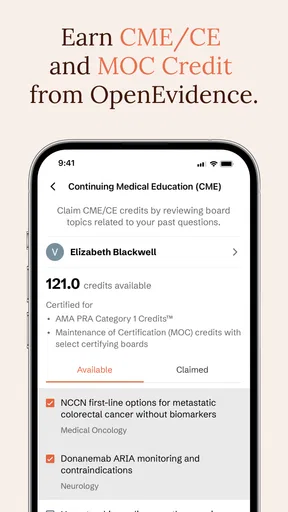
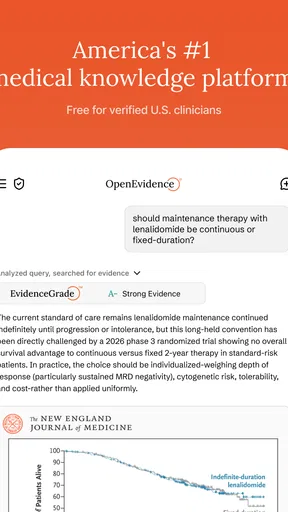
- Provides quick, evidence-based answers for healthcare professionals.
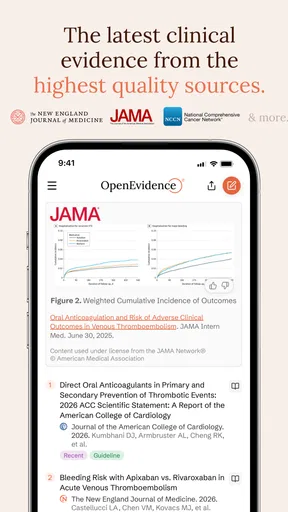
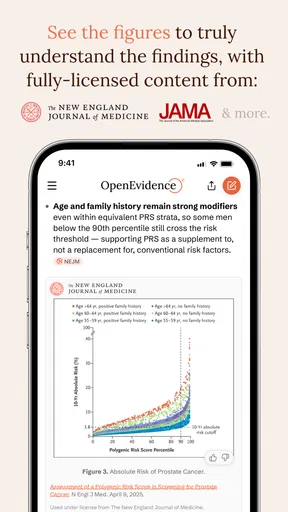
- Sources medical responses with links to supporting literature.
- Useful for checking clinical questions during busy workdays.
- Designed with a focused interface and minimal distractions.
- Can help organize complex medical information into concise summaries.
Limitations of OpenEvidence
- Access may be limited to verified healthcare professionals.
- AI-generated answers still require careful clinical verification.
- Some topics may have incomplete or outdated supporting evidence.
- The quality of results depends heavily on the question wording.
- Not a substitute for official guidelines, diagnosis, or professional judgment.
Similar Picks in This Category
View All
WebMD: Symptom Checker
WebMD, LLC4.1

Microphone Amplifier
DOSA Apps4.2

Anatomy Learning - 3D Anatomy
3D Medical OU4.5

Period Tracker and Calendar
SimpleInnovation4.9

GoodRx: Prescription Coupons
GoodRx4.8

CVS Health
CVS Pharmacy4.5
Frequently Asked Questions
What is OpenEvidence and who is it designed for?
OpenEvidence is an AI-powered medical information platform designed primarily for healthcare professionals, students, and other users who need quick access to evidence-based clinical knowledge. It is intended to support research, learning, and point-of-care decision-making by summarizing medical information and citing relevant sources. It should be treated as an educational and reference tool, not as a replacement for professional judgment, institutional protocols, or direct patient evaluation.
Can OpenEvidence be used to diagnose patients or recommend treatment?
OpenEvidence may help users explore medical literature, clinical topics, and possible considerations, but it should not be used as an independent diagnostic or prescribing authority. AI-generated responses can be incomplete, outdated, or unsuitable for a specific patient’s circumstances. Before applying any information in practice, users should verify the original sources, consider current guidelines, review the patient’s complete history, and consult an appropriately qualified healthcare professional.
Is OpenEvidence free to download and use?
Availability, pricing, and access requirements may depend on the platform, region, account type, and the user’s professional or educational affiliation. Some features may be available without payment, while advanced tools or institutional access could require registration, verification, or a subscription. Before downloading, check the current listing and the service’s official terms for information about trials, in-app purchases, eligibility, renewal conditions, and whether all advertised features are included in the basic version.
How reliable are the answers and medical sources provided by OpenEvidence?
OpenEvidence is designed to provide evidence-oriented medical information, which can make it useful for quickly reviewing complex subjects. However, no AI system is error-free. Answers may misinterpret a question, omit important context, or rely on sources that have changed since the response was generated. Users should inspect citations whenever available, compare information with trusted guidelines and primary literature, and avoid relying on a single generated answer for urgent or high-risk clinical decisions.
Does OpenEvidence protect personal health information and user privacy?
Privacy protections and permitted data use depend on the app’s current policies, account settings, and the way the service is accessed. Users should read the privacy policy and terms before entering any information, especially patient-related details. As a general precaution, do not submit identifiable patient data, confidential records, or sensitive personal information unless the service explicitly confirms that the relevant privacy and security requirements are met for that use.
